


Dandelions, Dye Pots, and Determination - A Dandelion Yarn Dyeing Experiment

Every spring, my yard, like countless yards, fields, roadsides, and empty lots, becomes dotted with dandelions. Bright yellow flowers appear almost overnight, covering the landscape in gold before eventually transforming into familiar white seed heads that drift away on the wind. Personally, I find this so pretty!

For many people, dandelions are little more than weeds. They are pulled, sprayed, mowed, and generally viewed as something unwanted. But the more I learn about them, the harder it's become to see them that way.
Dandelions are one of the earliest food sources available to bees and other pollinators in the spring. Their leaves, flowers, and roots have been used for centuries in cooking, herbal remedies, teas, wines, and natural dyes. They help loosen compacted soil with their deep taproots and provide valuable nutrients to insects emerging after winter. When you start looking closer, they seem less like weeds and more like remarkably useful plants that happen to grow where they please.

As a yarn dyer, I have a habit of looking at the world a little differently. A rusty gate might suggest a colour palette. A weathered barn might inspire a tonal colourway. And a weed blooming along the roadside makes me wonder what colour it might leave behind.
Dandelions have been on my mind for a while. Last spring, I picked a few bags full of flowers and tucked them away in the freezer with plans to experiment later. When I finally got around to using them, the results were disappointing. The colour was faint and very diluted, likely due to the moisture content added to the flowers during freezing.
Still, I couldn't quite let the idea go. So when the dandelions arrived en masse this spring, I decided to try again. This time I was determined to do it properly.

Over several days I collected nearly two pounds of fresh flowers from my yard and the surrounding area.
The final harvest weighed approximately 1 lb of dandelion heads.
Could I finally turn these so-called weeds into yarn?
The answer, it turns out, was a little more complicated than I expected.
Preparing the Yarn
Before dyeing, the yarn needed to be mordanted.
A mordant helps natural dyes bond to fibre and improves colour retention. For this experiment I used alum (potassium aluminum sulfate), one of the most commonly used mordants in natural dyeing.
The alum was dissolved in warm water before the yarn was added and allowed to soak.
Once mordanted, the yarn was ready for the dye pot.
Alum Powder Diluting the alum Mordanting the yarn in the alum
Creating the Dye Bath
The dandelion flowers were simmered to extract their colour, creating a surprisingly vibrant golden dye stock.
Pro tip: don't boil the dye bath. Lower heat is better for colour extraction and helps preserve the quality of the dye.
At this point I was feeling optimistic.
The dye bath looked rich and intensely coloured. The yarn was submerged and heated gently.
Dandelions in the dye bath Dandelion dye bath Yarn in dye bath
The yarn itself looked bright yellow in the pot, and I was already imagining rich golden skeins drying on the rack.
Unfortunately, natural dyeing likes to keep you humble.
The First Surprise
When the yarn came out of the dye bath and dried, the results were far lighter than expected.

Despite the vibrant colour of the dye bath, most of the colour remained in the water rather than transferring to the yarn.
The dye bath itself was still intensely yellow after the yarn was removed.
I began wondering if I had used enough flowers, enough mordant, or if the super wash yarn itself was affecting dye uptake.
So I decided to keep experimenting.
Attempt Two
The same yarn went back into a second dandelion dye bath.
This time I added additional alum directly to the dye bath and left the yarn to cool overnight.
The colour deepened slightly, but still not to the rich yellow I had imagined.
At this point I had a beautiful soft buttery yellow, but curiosity got the better of me.
What would happen if I modified the colour?
Enter the Tea

Natural dyers have used tannins for centuries to alter and deepen colours. Black tea is rich in tannins, so I steeped a couple of black tea bags and prepared a second bath.
This time, I was mindful about the amount of water I added to the dye bath because I didn't want to dilute the colour. I then added two of the yellow skeins to the tea bath while the remaining skeins were left in their original dandelion colour.
The transformation was immediate.
The soft buttery yellow shifted into warm honey tones and the black tea gently glazed the yarn.
The Final Results
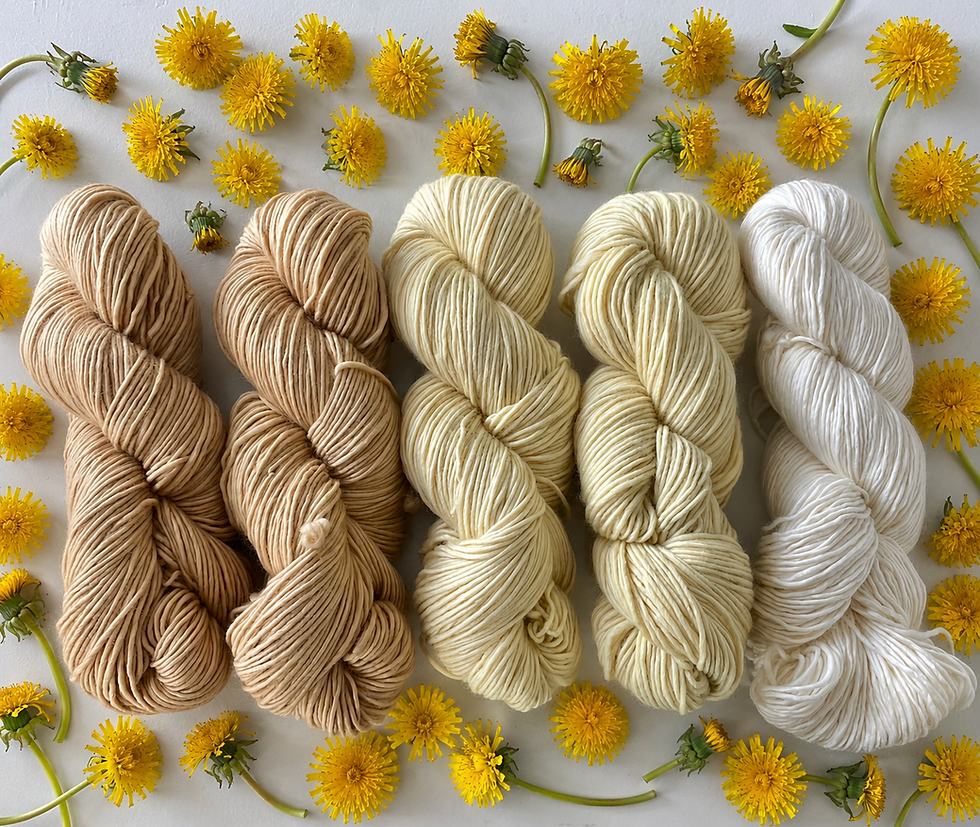
From left to right, the skeins tell the story of the experiment:
• Twice Steeped — dyed with dandelions and modified with black tea
• Wallflower — dyed exclusively with dandelions
• Undyed yarn for comparison
Giveaway!
One of the things I love most about dyeing yarn is sharing it with others.
Because this experiment produced just four finished skeins, I decided not to put them up for sale. Instead, I'm giving them away.
Two winners will each receive two skeins from this small-batch natural dye experiment:
☀️ Wallflower - two skeins dyed exclusively with dandelions
🍵 Twice Steeped - two skeins dyed with dandelions and modified with black tea
If you'd like to enter to win these skeins of 100% merino super wash fingering 1 ply, visit our Instagram pages @ravelutionyarn or @purls.ca / Facebook pages https://www.facebook.com/ravelutionyarn/ or https://www.facebook.com/Purls.ca/ for full giveaway details.
Good luck!
Dandelion dyed yarn Black tea dyed yarn Dandelion dyed yarn vs undyed yarn Black tea dyed yarn vs undyed yarn
Natural dyeing rarely gives you exactly what you expect.
Sometimes that's frustrating.
Sometimes that's magical.
And sometimes it reminds you that nature has its own plans.
One thing this experiment gave me was a tremendous amount of respect for natural dyers.
As someone who regularly works with acid dyes, I'm used to a process that is relatively predictable. If I carefully record my recipes, I can usually recreate a colour again and again with a high degree of accuracy, in a fraction of the time.
Natural dyeing is different.
The process is slower. It begins long before the yarn ever reaches the dye pot. Flowers/dye stuff must be gathered, mordants prepared, dye baths extracted, and countless variables considered. Even then, the final colour remains something of a conversation between the fibre, the plant material, the water, and time itself.
Not only are the results less predictable, they can be incredibly difficult to reproduce exactly. Two harvests from the same plant can produce different results. A change in season, growing conditions, or extraction method can shift the colour entirely.
Would I do it again?
Absolutely.
Next time, avocado pits, red onion skins, or maybe cochineal? You tell me!

Comments